For most custom boxing and Muay Thai shorts, choose sublimation when the design is full colour, covers large areas or uses gradients, and choose embroidery or an embroidered appliqué when you want a raised, premium-looking logo or name on a darker satin base. Screen printing suits simple one- or two-colour logos repeated across a larger team order. Many good fight shorts combine methods: a sublimated or solid body with an embroidered waistband logo or name.
This guide is for fighters, gyms, teams and brands ordering custom shorts. It compares the three main decoration methods, explains what each one needs from your artwork, and shows which questions to settle before you approve a proof. It does not replace your organiser’s uniform rules: if the shorts are for sanctioned competition, check the current kit and advertising rules first.
Quick comparison: sublimation, embroidery and screen printing
| Factor | Sublimation | Embroidery / embroidered appliqué | Screen printing |
|---|---|---|---|
| How it works | Heat turns dye into a gas that bonds with polyester fibres, so the design becomes part of the fabric | Thread is stitched into the fabric, sometimes around a fabric or leather-look patch (appliqué) | Ink is pushed through a mesh screen; one screen per colour |
| Best for | All-over graphics, gradients, photos, many sponsor logos | Names, gym logos and waistband marks that should look raised and premium | Bold one- or two-colour logos on larger runs |
| Fabric needed | High-polyester fabric with a white or light base | Most shorts fabrics, with the right backing to stop puckering | Most fabrics; flexible inks matter on stretch areas |
| Feel on the shorts | No added layer; the fabric feels the same | Adds thickness and some weight, especially for large designs | A thin ink layer sits on the surface |
| Fine detail | Very good, including small text and gradients | Limited: very small text and thin lines fill in | Good for solid shapes; gradients need halftones |
| Colour count | Unlimited, no extra cost per colour | Each thread colour adds work; gradients are hard to imitate | Each colour needs its own screen and setup |
| Main risk | Cannot print true white or light colours onto a dark base | Puckering on thin satin; bulk on large logos | Rigid ink can crack where the fabric stretches |
When sublimation is the right choice
Choose sublimation when the whole short is the design. If you want an all-over pattern, a gradient, a photographic graphic or a busy sponsor layout, sublimation is usually the most practical method because it has no colour limit and adds no layer that can peel or crack.
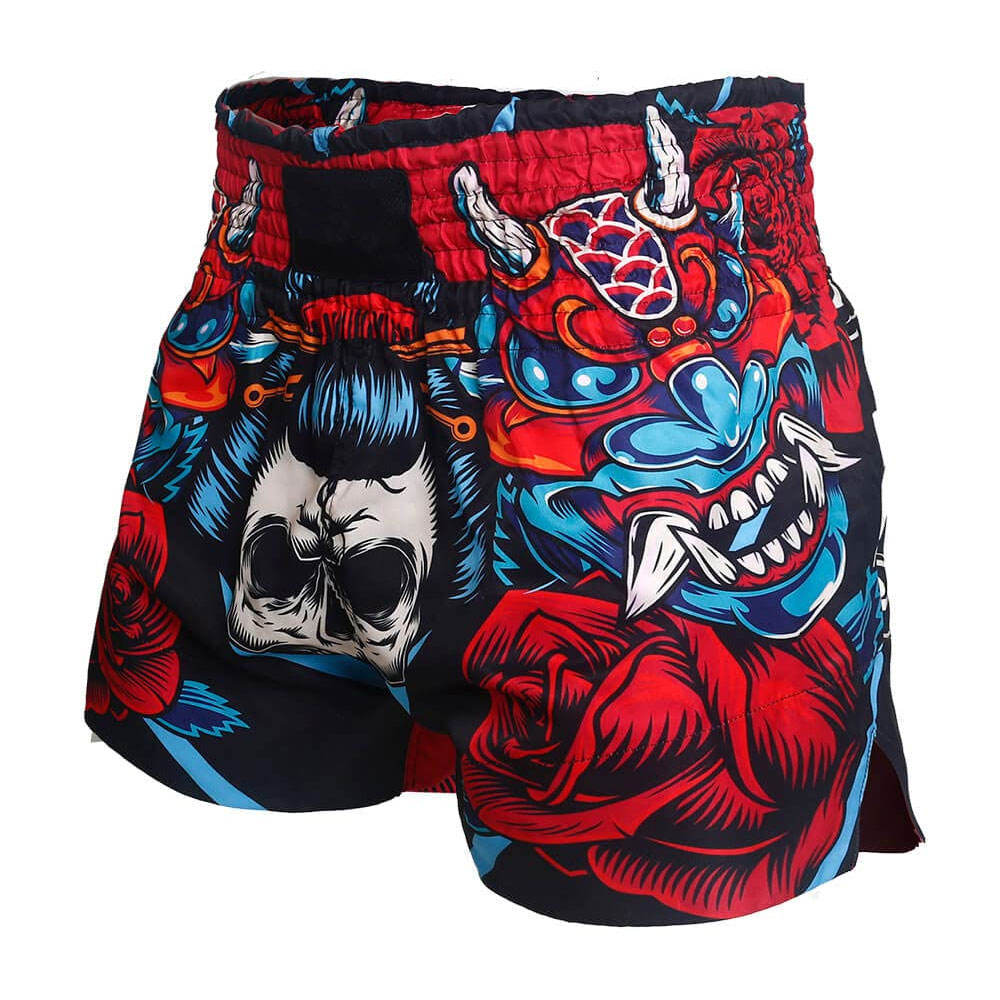
Three conditions decide whether it will work:
- The fabric must be polyester or mainly polyester. Sublimation dye bonds with polyester, not cotton. On blends, only the polyester part holds the colour, so the print looks weaker as the polyester share drops.
- The base must be white or light. Sublimation dye is transparent and printers do not print white. Any white in your design is simply unprinted white fabric. That is why a sublimated “black” short is normally white fabric printed black, rather than black fabric printed with colour.
- The look will be different from traditional satin. Fully sublimated shorts are often made from a smoother, less shiny polyester. If the shine of classic satin is part of your brand, ask for a fabric sample before you commit.
Ask the factory how white areas, seams and folds will look. Because the print is applied to the fabric before or during cutting and sewing, an important graphic can be interrupted by a seam or hidden in the gathered waistband. A proof should show where every element lands.
When embroidery or appliqué is the right choice
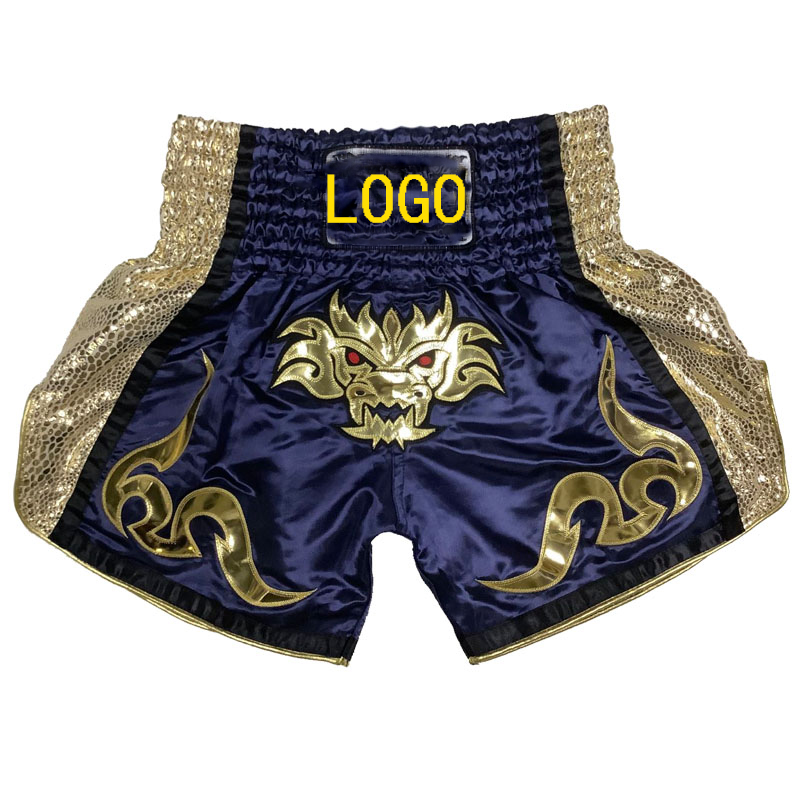
Choose embroidery when you want a raised, premium logo or name, especially on darker satin. Thread sits on top of the fabric, so a white or gold name stays bright on a black or navy body. This is something sublimation cannot do.

Keep these limits in mind:
- Small text has a floor. Embroidery digitising guides commonly put the practical minimum letter height at around 5–6.5 mm (about 0.2–0.25 in), with strokes of roughly 1 mm. Fine script, hairlines and tiny sponsor text usually need to be enlarged, simplified or switched to print.
- Thin satin needs the right backing. Without a suitable stabiliser, dense stitching can pucker lightweight fabric. Ask the factory how it prevents puckering on your chosen fabric.
- Large solid embroidery adds weight. For big front graphics, an appliqué uses a fabric patch with a stitched edge, so it stays lighter and more flexible than filling the whole area with thread.
- Gradients do not translate well. Embroidery imitates shading by layering thread colours, which adds bulk and rarely matches the artwork exactly.
When screen printing makes sense
Choose screen printing for a simple, bold logo in one or two solid colours on a larger order. Each colour needs its own screen, so setup costs are high for small runs but spread out well once the quantity rises. That is why decorators often set minimum quantities for this method.
It is less suitable when the design has many colours, fine gradients or sits on an area that stretches a lot. Standard ink forms a film on top of the fabric; if it is too rigid for the stretch it can crack. If you choose screen printing, ask which ink is used and whether it is suitable for stretch fabrics.
Decision guide: which method for which design?
- Full-colour fight-night design, gradients or many sponsors: sublimation on a light polyester base.
- Classic shiny satin with a fighter name or gym logo: embroidery or embroidered appliqué.
- Dark body with bright logos: embroidery or appliqué; avoid relying on sublimation for light colours on dark fabric.
- Gym or team order with one simple logo in one or two colours: screen printing, or embroidery if you want a raised finish.
- Very small text, such as a sponsor line on the leg: print it, or enlarge it before choosing embroidery.
- Mixed design: combine methods, for example a sublimated body with an embroidered waistband name. Approve each element’s method separately on the proof.
Common mistakes and what they cost you
- Ordering sublimated colour onto black satin. The colours will barely show. Decide early whether you want a dark satin look (embroidery or appliqué) or a full-colour print (sublimation on a light base).
- Sending a print file for an embroidered logo. Embroidery artwork has to be digitised into stitches. Fine details may be simplified, so check the stitched proof, not just the original logo.
- Placing a key logo across a seam or the gathered waistband. It may be cut, hidden or distorted. Ask the designer to flag elements that cross seams or trims.
- Choosing by sample photos alone. Screens and photos show colour differently. If the exact colour matters, give a colour reference and ask how the selected fabric and method will affect it.
What PAILK can confirm for your order
PAILK’s custom boxing shorts service includes dye-sublimation printing, embroidery and printing for logos, graphics and text, as well as trims such as piping, contrast stitching and coloured waistbands. Ask our designers to recommend a method for each logo and to name it on the proof. According to our custom boxing shorts guide, design and manufacturing usually take two to three weeks depending on design complexity. Shipping time is separate. Order changes are accepted within 24 hours of ordering, so settle the decoration method before you confirm.
What to send for a decoration recommendation
Copy this list into your enquiry so the designer can suggest the right method for each element:
- Shorts style: boxing, Muay Thai, kickboxing or MMA
- Preferred body fabric and look: shiny satin or a matte, sport-style finish
- Main body, waistband and trim colours
- Each logo or text element, with its position (waistband, front, left leg, right leg, back) and approximate size
- Your preferred method for each element, if you already have one
- Original artwork files: vector files such as AI, EPS, SVG or PDF where available. See our artwork checklist.
- Quantity and size breakdown
- Delivery country and required event date
Send the list to PAILK for a design review and quote, and ask for a proof that names the decoration method for every element before production starts.